
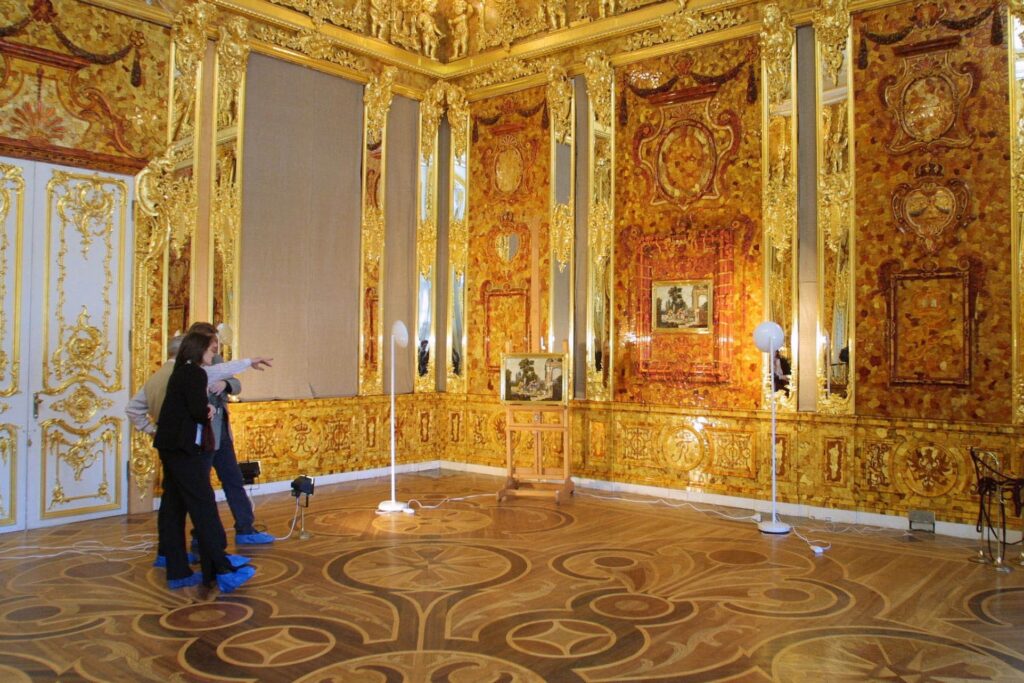
The Amber Room: A Timeless Piece of Russian History
The Amber Room is one of the world’s most famous works of art and a true masterpiece of Baroque art. Located in the Catherine Palace of Tsarskoye Selo near Saint Petersburg in Russia, the Amber Room was a unique and precious gift from Prussia to the Russian Tsar Peter the Great in 1716. For many years the Amber Room was a symbol of Russia’s wealth and power and it is often referred to as the “Eighth Wonder of the World”.
History of the Amber Room
The Amber Room was designed and constructed by the German baroque sculptor Gottfried Wolfram and German cabinetmaker Andreas Schlüter in 1701. Originally, the walls of the room were decorated with sheets of amber, gold leaf and mirrors. It was a gift to the Russian Tsar Peter the Great from Prussia’s King Friedrich Wilhelm I.
In 1755, the room was reconstructed by Tsarina Elizabeth with the help of Italian craftsmen who added more amber and gilded carving to the walls. The room was further decorated by Catherine the Great in 1770 with the addition of paintings, valuable carpets and furniture.
The room’s exquisite beauty led it to become a favorite of Catherine the Great and it was often used as a reception room for foreign dignitaries. Unfortunately, the Amber Room was looted by Nazi forces during World War II and it has not been seen since.
The Disappearance of the Amber Room
In 1941, the Nazis plundered the Catherine Palace and took the Amber Room to Konigsberg Castle in East Prussia, where it was reconstructed. When the Red Army reached Konigsberg in 1945, the Amber Room was nowhere to be found. It is believed that the Nazis disassembled and hid the room before they fled the city.
The Search for the Amber Room
In the decades since the room disappeared, there have been numerous attempts to find the missing Amber Room. These attempts have included searches of castle ruins, secret archives and abandoned mine shafts. Unfortunately, none of these attempts have yielded any results and the Amber Room’s whereabouts remain a mystery.
A Reconstruction of the Amber Room
In 1979, the Soviet Union began a project to reconstruct the Amber Room. The project was completed in 2003 and the reconstructed Amber Room was unveiled at the Catherine Palace. The room was reconstructed using the original 18th-century designs and more than six tons of amber.
Today, the reconstructed Amber Room is one of the most popular attractions of the Catherine Palace and it is a reminder of the room’s beauty and grandeur. It is a testament to the skill of the original artists and artisans, and it serves as a reminder of the resilience of the Russian people and their ability to overcome adversity.
Conclusion
The Amber Room is a beautiful and timeless piece of Russian history. While its original whereabouts remain unknown, its reconstruction is a reminder of the room’s grandeur and its enduring legacy. The story of the Amber Room is one of intrigue, loss, and enduring fascination. As a masterpiece of Baroque art and a symbol of Russia’s wealth and power, its disappearance during World War II captured the imagination of people around the world. Despite decades of searches and attempts to locate the original room, its whereabouts remain a mystery.