
Introduction
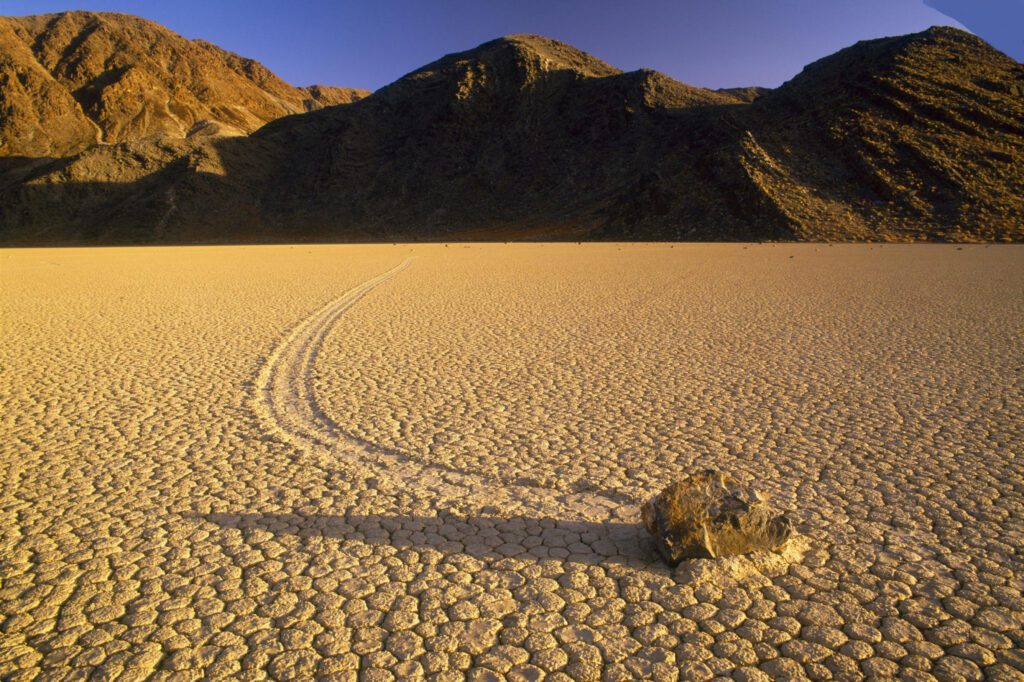
The Racetrack Playa is a dry lakebed located in Death Valley National Park, California. It is known for its mysterious moving rocks, nicknamed “sailing stones”, which leave visible trails in the mud as they move. These rocks are known to move up to several hundred meters in a single night, and the source of this phenomenon has baffled scientists for decades. In this article, we will explore the unique mystery of the Racetrack Playa and the sailing stones.
What is Racetrack Playa?
Racetrack Playa is a dry lakebed in the northern part of Death Valley National Park. It is surrounded by the Panamint Range mountain to the west and the Cottonwood Mountains to the east. The lakebed is approximately 3.4 miles long and 1.5 miles wide, and is almost completely flat, with a few shallow basins scattered across the surface. The surface of the playa is made of mud, and when the lakebed is dry, it is covered with a layer of cracked mud and smooth, rounded stones.
The Mysterious Sailing Stones
The strange phenomenon of the sailing stones occurs when the lakebed is covered in a thin layer of water. The stones, which are mostly composed of dolomite and syenite, are then pushed across the lakebed, leaving visible trails in the mud. Scientists believe the stones are moved by strong winds, combined with the surface tension of the water.
The stones typically move in a straight line, but can sometimes move in circles or zig-zags. The stones can move up to several hundred meters in a single night, and the tracks they leave behind can last for months or even years.
Scientific Studies of the Sailing Stones
The mystery of the sailing stones has intrigued scientists and visitors alike since the early 1900s. Several studies have been conducted to try and understand the phenomenon, but the exact cause of the stones’ movement remains unknown.
In 2014, a team of researchers from Scripps Institution of Oceanography and the Smithsonian Institution conducted a study of the sailing stones. They used GPS devices to track the movement of the stones over several months, and found that they moved on average 10 meters per minute. The researchers also found that the stones moved more quickly during higher wind speeds, and the trails they left behind were curved due to the movement of the stones.
Conclusion
The sailing stones of Racetrack Playa are a unique phenomenon that has puzzled scientists for decades. The stones are thought to be moved by strong winds, combined with the surface tension of the water, but the exact cause of their movement remains unknown. Several studies have been conducted to try and understand the phenomenon, but the mystery remains. Racetrack Playa is a fascinating place to visit, and it’s sure to leave you with a sense of wonder and fascination.